Introducing Vidos EUDI Use Case Demos
Vidos EUDI Use Case Demos are built to help teams make EUDI wallet journeys tangible, testable, and easier to implement. If your team is currently translating EUDI requirements into roadmap items, this can help you move from abstract planning to practical implementation decisions faster.
- Published on
The EUDI ecosystem is moving fast. Teams now have clearer policy direction, stronger technical specifications, and published use case manuals. But one gap remains common across product and engineering teams: converting that guidance into a working implementation you can actually test.
We are launching Vidos EUDI Use Case Demos to help close that gap.
- Live demonstrator: https://eudi-usecase.demo.vidos.id/
- Open-source code (MIT): https://github.com/vidos-id/usecase-demos
This launch is designed to be practical. You can run the journey yourself in the browser, inspect the code, and use it as a baseline for your own internal experiments.
What is included in this launch
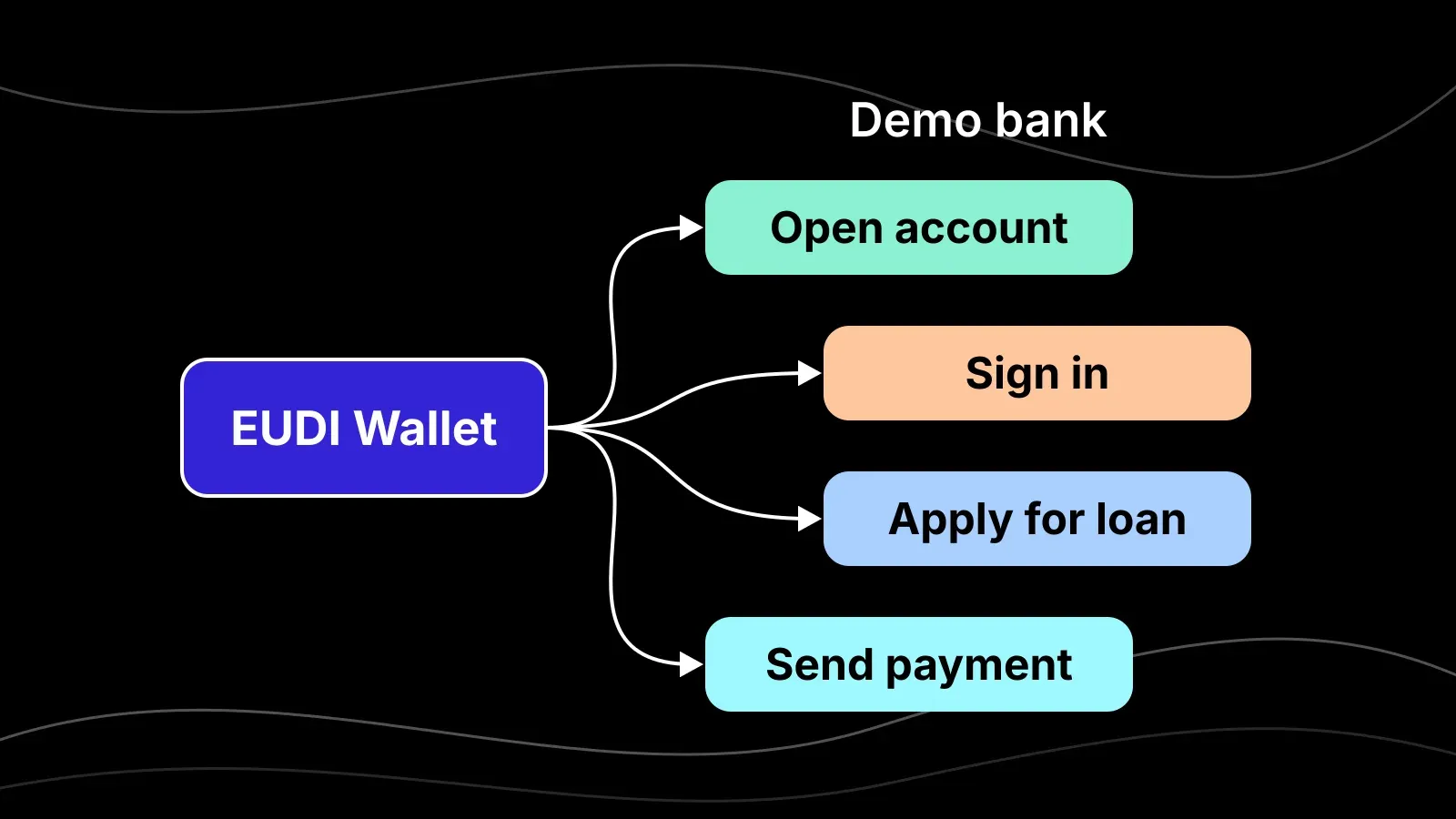
The first public demo is VidosDemoBank, a banking scenario built to show realistic wallet-based user journeys, not just isolated protocol calls.
In the current flow, users can:
- Create an account
- Sign in
- Apply for a loan
- Send a transaction
These are the same kinds of actions teams often need to model when designing EUDI-ready customer experiences: onboarding, returning access, and step-up identity confirmation for sensitive actions.
Why we built this
Most teams evaluating EUDI verifier journeys face the same challenge: they can read specifications, but they still need a concrete, runnable reference to align architecture, UX, and delivery decisions.
The goal of this demonstrator is to provide that reference.
Instead of starting from a blank repository, teams can work from a real implementation that already expresses key identity flow patterns. That shortens time-to-learning and improves stakeholder alignment across product, engineering, and compliance.
What teams can validate technically
The demo and repository are built to let teams validate implementation choices early:
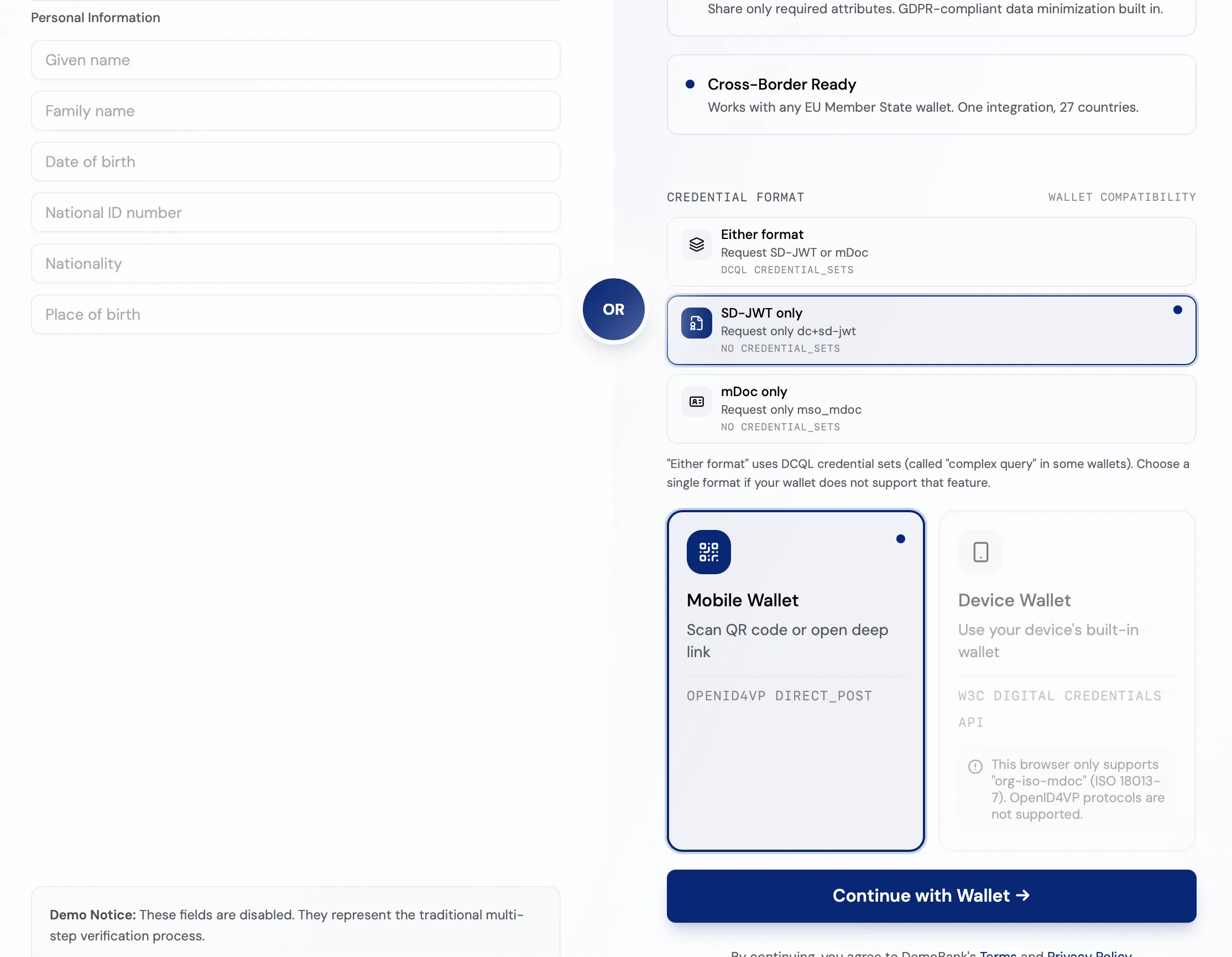
- PID-based identification journeys for account creation and account access
- Identity confirmation patterns for higher-risk actions (loan and transaction flows)
- Presentation protocol paths, including OpenID for Verifiable Presentations (OID4VP) and the Digital Credentials API (DC API)
- Credential format coverage for SD-JWT VC and mDoc representations
- Selective disclosure experience where requested attributes are constrained to the journey needs
These are exactly the kinds of technical and product details that are easier to understand in a running application than in diagrams alone.
Alignment with EUDI use case guidance
This launch is aligned with the direction and structure of the published EUDI use case manuals, especially for identification and payment-related journeys.
Useful references:
To keep the scope clear: this demonstrator shows practical identity and confirmation journeys in a banking context. It is intended as an implementation reference and learning tool, not as a statement of full production or regulatory completeness for all payment-authentication scenarios.
Why open source matters here
Identity systems depend on trust. For implementation teams, trust is stronger when behavior is inspectable.
By releasing the code under MIT license, this project gives teams a transparent baseline they can review, run, adapt, and discuss internally. That makes it easier to:
- Validate architecture assumptions
- Map user journeys to implementation details
- Accelerate prototype and workshop work
- Reduce ambiguity in cross-functional reviews
In other words, this is not just a live demo to click through. It is also an inspectable reference for real engineering conversations.
Who should use this now
This demonstrator is useful for:
- Product and engineering teams planning wallet-first onboarding journeys
- Architects evaluating verifier integration patterns and protocol choices
- Compliance and programme teams aligning delivery plans with EUDI manuals
- Ecosystem partners who need a concrete baseline for collaborative design sessions
If your team is currently translating EUDI requirements into roadmap items, this can help you move from abstract planning to practical implementation decisions faster.
Quick start
- Open the live demo and complete the core journey: https://eudi-usecase.demo.vidos.id/
- Inspect the repository structure and implementation choices: https://github.com/vidos-id/usecase-demos
- Use the flow as a reference for your own internal prototype or workshop.
Give it a try
Vidos EUDI Use Case Demos are built for one purpose: helping teams make EUDI wallet journeys tangible, testable, and easier to implement.
If you are designing EUDI-ready services, start by trying the live demonstrator, then inspect the code and map what you learn into your own delivery plan.
- Live demo: https://eudi-usecase.demo.vidos.id/
- Repository: https://github.com/vidos-id/usecase-demos
Talk to our team
Have a question or want to chat about how Vidos can help? Reach out to our team of real-world practitioners today.
Want to learn more?
Download our guide:
The Evolution of Digital Identity
As we delve into the history, milestones, case studies, and future directions of digital identity, this guide aims to provide a comprehensive overview of its evolution. Through this exploration, we hope to shed light on the importance of digital identity in shaping our digital futures, preparing us for the next chapter in this ever-evolving narrative.
Download here