
- Education & Employment
Verify a diploma or certificate at the moment someone applies.
Universities, employers and professional bodies check qualifications every time someone applies for a course, a job or a licence to practise. When the awarding body issues the qualification as a signed credential, the check runs against the awarding body's signature in seconds.
The challenge in education
Most qualifications still travel as paper certificates or PDFs. Admissions offices and employers either take them on trust or contact the awarding body to confirm them, which can take days and is harder across borders and languages. Learners repeat the process for every application, and the growing number of short courses and micro-credentials adds more documents to check.
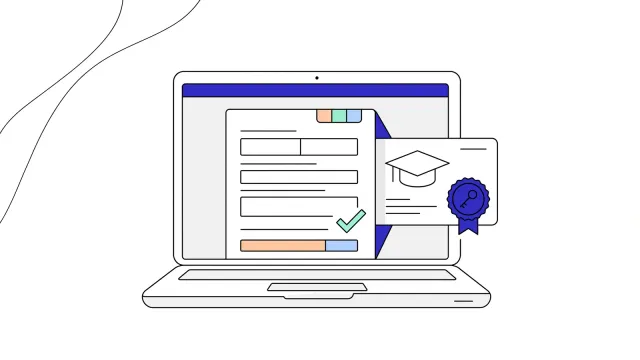
A qualification issued as a verifiable credential carries the awarding body's electronic seal. The learner keeps it in a wallet and shares it with each application, and the receiving organisation verifies who issued it and confirms it is unaltered and still valid.
Where verification is needed
- University admissions: verifying prior qualifications and transcripts, including from other countries
- Recruitment: confirming a candidate's degree or certificate before an offer
- Professional registration: checking qualifications before admitting someone to a regulated profession
- Student status: proving enrolment for discounts, visas or student services
- Training providers: verifying prerequisites before enrolling a learner on a course
What Vidos does
- Vidos Authorizer asks the learner's wallet for the qualifications your process requires, over OpenID4VP
- Vidos Verifier checks the signature, expiry and revocation status of W3C VC and SD-JWT VC credentials
- Vidos Universal Resolver resolves the awarding body's decentralised identifier to its public keys
- Vidos Validator applies your entry rules, such as qualification level, subject or award date
- Each verification is logged, giving admissions and HR teams an audit record of what was checked
European context
European Digital Credentials for Learning, issued through Europass, follow the European Learning Model, align with the W3C Verifiable Credentials data model and must be signed with an electronic seal from a trust service provider under eIDAS. The European Blockchain Services Infrastructure (EBSI) runs a diploma use case for cross-border verification, and the DC4EU large-scale pilot, which concluded in July 2025, tested educational credentials and professional qualifications with the European Digital Identity Wallet.
Article 5f(2) of the eIDAS Regulation, as amended by Regulation (EU) 2024/1183, lists education among the sectors where private providers that must use strong user authentication have to accept the wallet at the user's request by 24 December 2027.
Ready to get started?
Explore the verification infrastructure that organisations across Europe are using to accept digital credentials.